
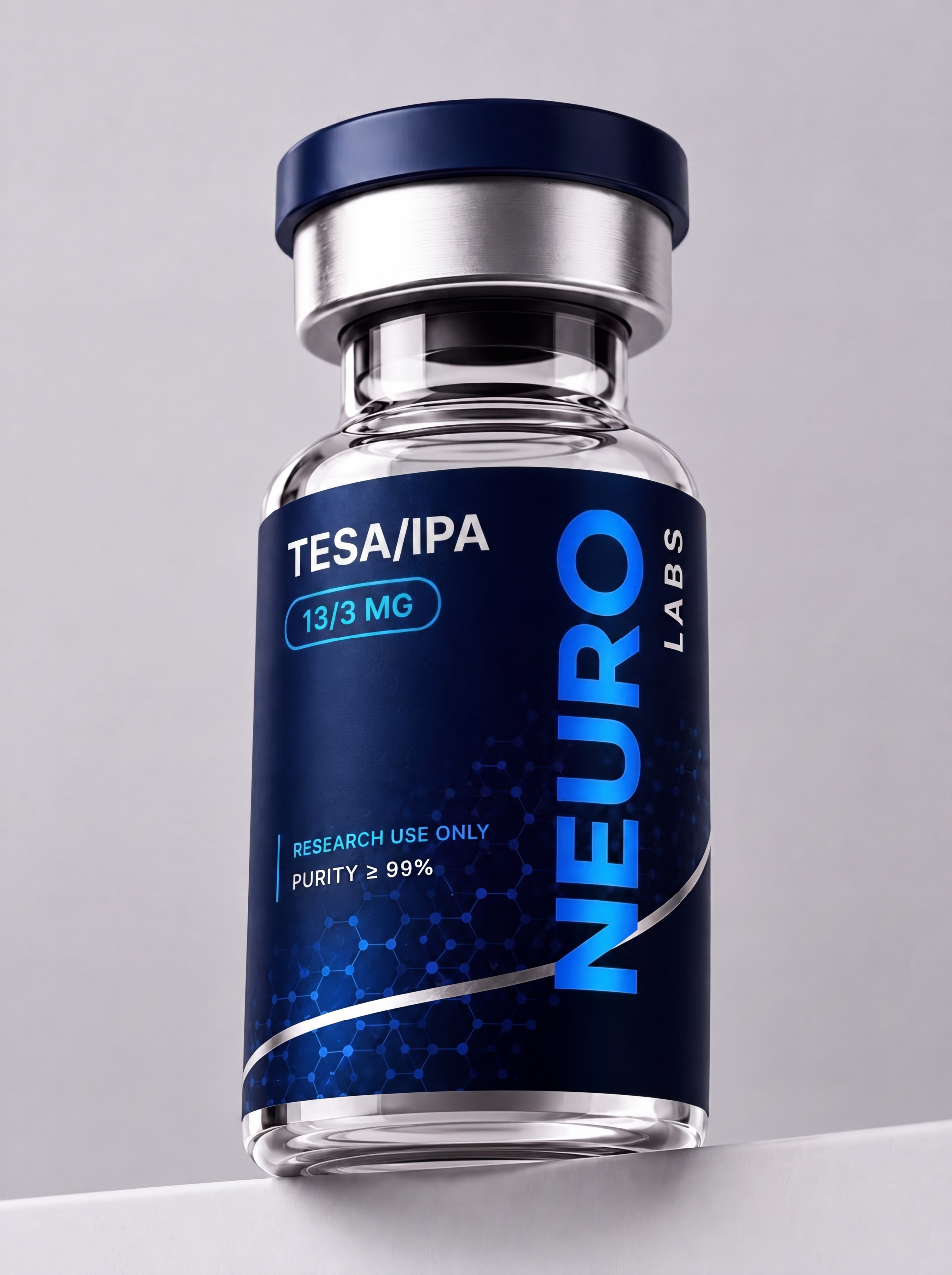

TESAMORELIN/IPAMORELIN (13/3MG)
At NeuroLabs Research, our multi-peptide research blends are synthesized to provide scientific laboratories with coordinated biochemical systems designed for comprehensive multi-target pathway investigations. The TESAMORELIN/IPAMORELIN (13/3MG) unites stoichiometric ratios of complementary research peptides into a single standardized formulation, enabling investigators to observe cross-pathway signaling cascades and synergistic receptor interactions without compounding discrepancies. Engineered to support demanding preclinical evaluations, this specialized research blend represents an advanced offering within our Blends category.
Listing Details & Specifications
| Specification / Feature | Details |
|---|---|
| Product Name | TESAMORELIN/IPAMORELIN (13/3MG) |
| Formulation Classification | Multi-Target Synergistic Research Blend |
| Physical Presentation | Sterile Sealed Borosilicate Glass Vial |
| Physical Form | Lyophilized Solid Micro-Crystalline Cake |
| Purity Benchmark | ≥99.0% Assayed for Each Active Constituent via HPLC |
| Identity Verification | Electrospray Ionization Mass Spectrometry Confirmed |
| Reconstitution Vehicle | Bacteriostatic Water / Sterile Physiological Saline |
| Storage Conditions | -20°C Cryopreserved Storage in Desiccated Chamber |
| Packaging Matrix | Hermetically Sealed Vial with Tear-Off Protective Cap |
| Research Focus | Cross-Pathway Signaling Synergy & Coordinated Receptor Kinetics |
The molecular engineering behind TESAMORELIN/IPAMORELIN (13/3MG) combines high-affinity active peptide sequences that target distinct receptor populations and intracellular signaling cascades. Each constituent sequence within the blend is independently synthesized via solid-phase peptide synthesis and purified by preparative chromatography to satisfy purity standards of ninety-nine percent or higher. Lyophilization under tightly regulated vacuum gradients yields a homogenous micro-crystalline cake that dissolves rapidly in laboratory solvents without molecular aggregation or precipitate formation, providing reproducible baseline data across serial testing runs.
Utilizing synergistic peptide blends in experimental models demands rigorous reconstitution protocols and meticulous quantitative handling. Reconstitute the lyophilized cake by gently introducing sterile bacteriostatic water or buffered laboratory saline along the inner borosilicate vial wall. Avoid vigorous agitation or mechanical vortexing, which can introduce hydrodynamic shear stress and compromise fragile tertiary peptide conformations. Allow the solid matrix to dissolve completely through gentle swirling, and partition into single-use aliquots to eliminate damaging freeze-thaw cycles.
When designing comparative preclinical protocols, researchers frequently assess SEMAX/SELANK (10MG) alongside TESA/CJC/IPA (20MG) and RT+TR (60MG) to establish correlated baselines and observe differential cellular response kinetics.
Preserving the molecular stability of TESAMORELIN/IPAMORELIN (13/3MG) requires strict adherence to low-temperature preservation guidelines. Store the sealed lyophilized vial at minus twenty degrees Celsius in a moisture-free desiccated storage unit shielded from radiant light. Once reconstituted into liquid working solutions, store active aliquots refrigerated between two and eight degrees Celsius for short-term evaluation, or flash-freeze at minus eighty degrees Celsius for prolonged assay archiving.
Analytical Quality Assurance & Verification Protocol: Independent reverse-phase HPLC and electrospray ionization mass spectrometry verify stoichiometric precision, chemical purity, and structural integrity across all blended components. Every individual batch synthesized for NeuroLabs Research undergoes rigorous orthogonal validation comprising reverse-phase high-performance liquid chromatography and electrospray ionization mass spectrometry to substantiate minimum purity thresholds exceeding ninety-nine percent. Spectroscopic analytical records confirm exact theoretical molecular mass alignment, absence of truncated peptide fragments, and stringent elimination of residual synthesis scavengers or volatile organic counter-ions. Lyophilization cycles are executed under computer-monitored ultra-low temperature and vacuum condensation gradients to produce structurally uniform cakes exhibiting rapid reconstitution kinetics and optimal thermodynamic stability during prolonged research storage. Sealed borosilicate containers are capped with inert halobutyl elastomeric stoppers and crimped aluminum protective closures under nitrogen purging to maintain strict moisture-free atmospheric barriers throughout transport and inventory archiving. Independent third-party laboratory verification protocols provide comprehensive analytical certificates confirming absence of heavy metal contaminants, bioburden sterility compliance, and precise active compound quantification across every production lot. Rigorous shelf-life stability monitoring confirms molecular conformation remains uncompromised when vials are preserved in desiccated environments at sub-zero temperatures, providing researchers consistent experimental reproducibility across serial assay timelines. Standardized batch tracking documentation and automated quality logging provide complete transparency across all manufacturing stages, from initial precursor qualification through final analytical packaging release. Analytical laboratories utilize calibrated spectroscopic equipment and computerized baseline integration to verify that peak area distributions conform precisely to established reference standards. Microbiological endotoxin testing via kinetic chromogenic assays verifies that all finished research units satisfy stringent purity specifications for sensitive cell-culture environments. Advanced chromatographic stationary phases and optimized binary mobile solvent gradients ensure high-resolution separation of closely related diastereomers and synthetic sequence analogs. Continuous cold-chain management and automated environmental climate monitoring during warehousing safeguard compound integrity against thermal fluctuations and photodegradation.
All multi-peptide formulations and research blends distributed by NeuroLabs Research are provided exclusively for in vitro laboratory research, preclinical cell biology, and scientific chemical analysis. These compounds are strictly not for human or veterinary administration..
Related products

Lab Supplies

Peptides

Peptides

Peptides

Peptides

Peptides

Lab Supplies
Lab Supplies